Solar Tracker Axis of Rotation
Solar trackers significantly increase photovoltaic system output compared to fixed-tilt ground mounts by continuously orienting solar panels toward the sun throughout the day. This guide breaks down the mechanics, coordinate systems, and kinematic axis configurations of single-axis and dual-axis solar tracking systems.
Unlocking the Power of the Sun: Solar Tracker Kinematics
Solar tracking systems rely on mechanical drives to rotate PV arrays along one or two degrees of freedom. Common drive systems include electric linear actuators, slewing drives, hydraulic cylinders, and pneumatic systems.
By maintaining an optimal angle of incidence ($\theta \approx 0^\circ$) between the incoming solar beam and the panel's surface vector, tracking systems capture substantially more daily irradiance than static mounting structures.
Reference Coordinate System
To analyze tracker movement, we adopt a standard 3D Cartesian coordinate system $(X, Y, Z)$:
- X-axis: Oriented along the East–West line.
- Y-axis: Oriented along the South–North line.
- Z-axis: Zenith axis, perpendicular to the Earth's surface.

Standard Cartesian coordinate reference frame (XYZ)

Cartesian reference applied to East-West tracking geometry
Single-Axis Tracking Configurations
Single-axis solar trackers rotate around a single vector. Depending on the spatial orientation of the rotation axis, single-axis systems are categorized into three primary types:
Case 1: Horizontal East-West Axis (Seasonal Tilt Adjustment)
The axis of rotation is aligned strictly East–West. Rotation along this axis tracks the sun's daily elevation (altitude angle) change across seasons.
Because solar altitude changes relatively slowly throughout the year, this system is often implemented as a manually adjusted tilt structure (like a multi-position frame). According to calculations performed in the SPAC (Solar Panel Angle Calculator) application, adjusting panel tilt on a monthly basis yields only about a 6% annual energy gain over an optimally fixed annual tilt angle.
Case 2: Vertical Axis Tracking (Azimuth Tracking)
The rotation axis is perpendicular to the ground (along the Z-axis). The array rotates 180 degrees from East to West following the sun's azimuth angle throughout the day.

Hydraulic actuator for seasonal tilt adjustment

Vertical Axis Rotation (Azimuth Tracking)
Case 3: Tilted Single-Axis Tracking (TSAT)
The axis of rotation is oriented North–South but elevated at a fixed tilt angle relative to the ground. During the day, panels sweep from East to West around this inclined axis.
By combining a permanent seasonal elevation angle with continuous daily rotation, Tilted Single-Axis Trackers achieve performance very close to full dual-axis tracking systems while utilizing only a single motor drive.

Daily panel rotation around an inclined North-South axis
Determining the Optimal Axis Tilt Angle
A common rule of thumb approximates the fixed structural tilt using the linear geometric formula:
However, testing within the SPAC application demonstrates that simple geometric formulas are sub-optimal because they ignore local atmospheric conditions, seasonal cloudiness profiles, and diffuse radiation ratios.
The SPAC algorithm computes optimal annual tilt by integrating site-specific microclimate data and hourly solar irradiation profiles rather than relying strictly on geographic latitude.

Monthly optimal panel tilt profile computed using site-specific climate data in SPAC
Dual-Axis Tracking Systems
Dual-axis trackers adjust both azimuth (East-West) and elevation (North-South) angles continuously. This ensures that solar rays strike the panel surface at a perpendicular angle ($\theta = 0^\circ$) at all times.
Compared to optimal fixed-tilt systems, dual-axis tracking increases annual energy yield by approximately 30% to 35% (as verified by SPAC simulation models).
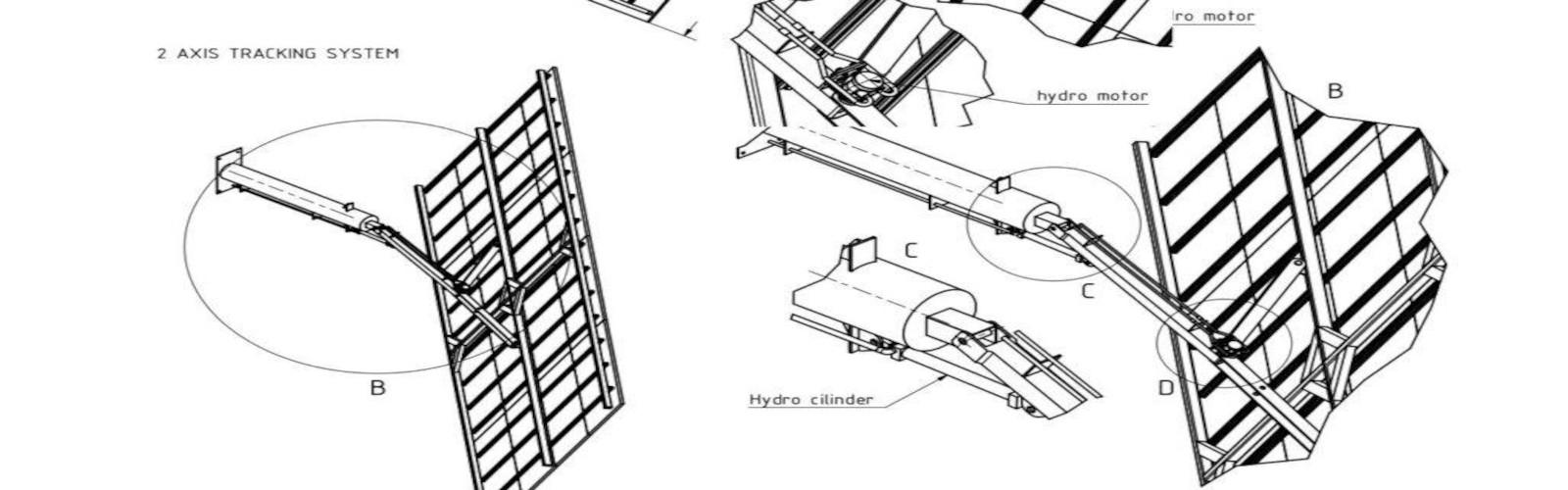
The trade-off is higher mechanical complexity: dual-axis systems require two independent actuators (e.g., a hydraulic motor for azimuth rotation and a hydraulic cylinder or linear screw actuator for elevation control) alongside advanced astronomical closed-loop control electronics.

Dual-axis solar tracking mechanism with dual-actuator drive
Conclusion
From an economic and structural efficiency standpoint, Tilted Single-Axis Tracking (Case 3) often provides the best compromise between complexity and yield. It captures the vast majority of dual-axis performance advantages while requiring only a single drive mechanism and significantly reducing long-term maintenance costs.
Related posts
SPAC 1.27 UI
The Solar Panel Angle Calculator (SPAC) has evolved from a simple tilt-angle computation tool...
Off Grid DC Voltage
Selecting the correct DC system voltage for an off-grid photovoltaic (PV)...


