solar panels east west roof - west or east-facing PV module
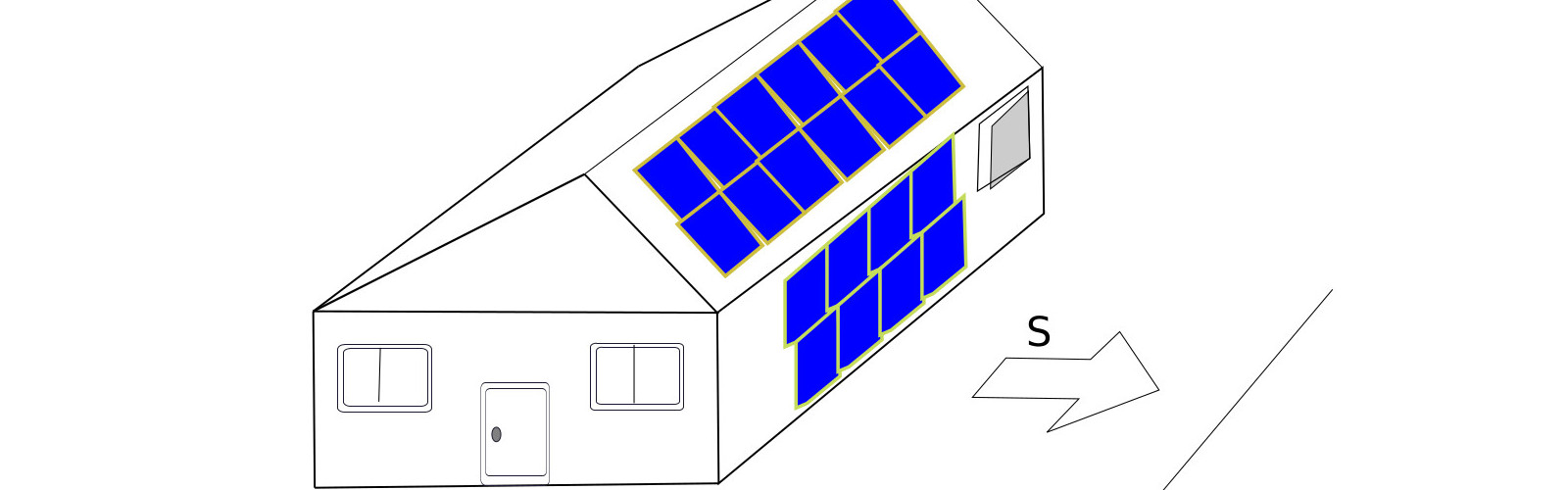
We all know about the recommendation that solar panels should be placed facing south for better utilization. If the configuration of the roof forces us to place the solar panels to the east or west, then we have limited options. What can we expect from this kind of solar panel setup? However, interest in installing photovoltaic systems on east-west roofs is constantly growing. Although they are south-oriented systems, better east-west-oriented PV systems can also bring significant profits. Moreover, the sharp drop in modulus prices is expected to drive increased demand for east-west systems in the future. From the perspective of network operators, solar panels facing east or west can work well.
East-West-facing solar panels can work well
Although south-oriented systems are a better option, east-west-oriented PV systems can also bring some profit. Moreover, due to the sharp decline, the demand for east-west systems also increased. Grid operators prefer east-west-oriented PV systems over south-oriented ones because they distribute energy more evenly throughout the day, reducing power peaks and relieving the network. Previously, it was assumed that PV systems oriented east-west required separate inverters for each orientation, or at least one inverter with multiple MPPs (maximum power point), to avoid mismatched losses. Most solar installers commonly use grid inverters to connect the solar panels in series with the electrical cable. A string refers to each group of panels connected in series. We connect each string to a separate input on the inverter. Often, in such cases, we connect several strings in parallel and then into one inverter input. To do this, each string must have the same number of panels and be of identical brands and models.
Connecting panels and inverters in a west-east configuration
If we put solar panels on the east and west parts of the roof, then we usually connect them separately and use two inputs into an inverter. However, under some circumstances, it is possible for east-west system solar panels to have a splitter on one input of the inverter. Why would SMP want to do this? Well, a single array inverter may be cheaper than a dual input inverter, or we may want to save the second input for the south-facing array if the roof configuration suits us. Any flat-roofed building, including large commercial installations, can also utilize racks to achieve the same result as houses with direct east- and west-facing roofs. The first scientific paper on this topic was published by engineer Dietmar Staudacher from the Fronius Institute in 2009. According to his work, the panels should be inclined as little as possible, around 24 degrees. We will verify this claim later with the SPAC application.
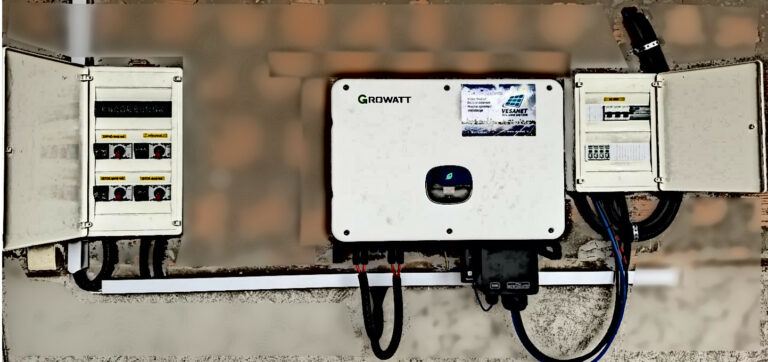
The Benefits Of An East-West Splitter
A few years ago, when solar panel prices were high, the best direction for the panels was south. So that they would produce the most electricity and make it possible to earn as much as possible. An east-west configuration can help us produce a stable amount of energy throughout the day. When the panels face south, they start producing energy in the morning, reach a maximum level at solar noon, and then decline during midday. With an east-west orientation, production should be stable with minor oscillations during the day. In order to see exactly what we gain and what we lose, we will perform an analysis using the SPAC application.
Analysis of the west-east system using the SPAC application
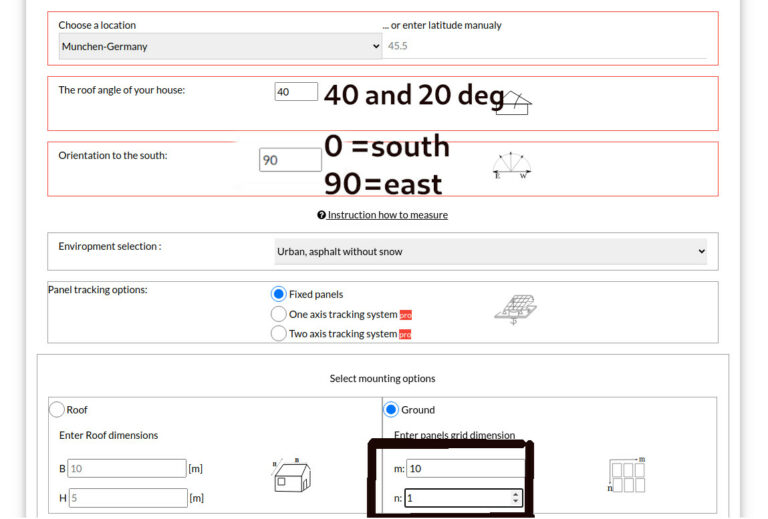
To analyze this case, I will use the SPAC application for Europe, which is available at the link.
- Location: Munich, Germany (chosen as a representative city in Central Europe)
- Equipment: 10 units of Canadian Solar CS3N-395 (395 W) configured as 10 pieces in one row
- Installation: Ground-mounted panels
- Note: Panel selection does not affect the analysis, as the goal is to calculate daily energy gain per unit area (kW/m²).
| Parameter | Value / Description |
|---|---|
| Tilt Angle | 40 degrees |
| Case 1 Orientation | 0 degrees (South-facing) |
| Case 2 Orientation | 90 degrees (East-facing / West yields identical results) |
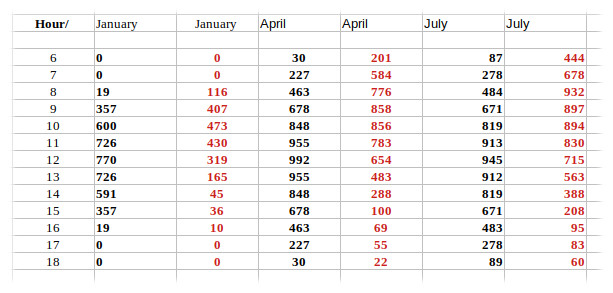
In that table, there are gains from radiation: direct, diffuse, and reflected, and their sum for each hour in the average day of the month of the year. The average day of the month in the year is adopted as the 15th.
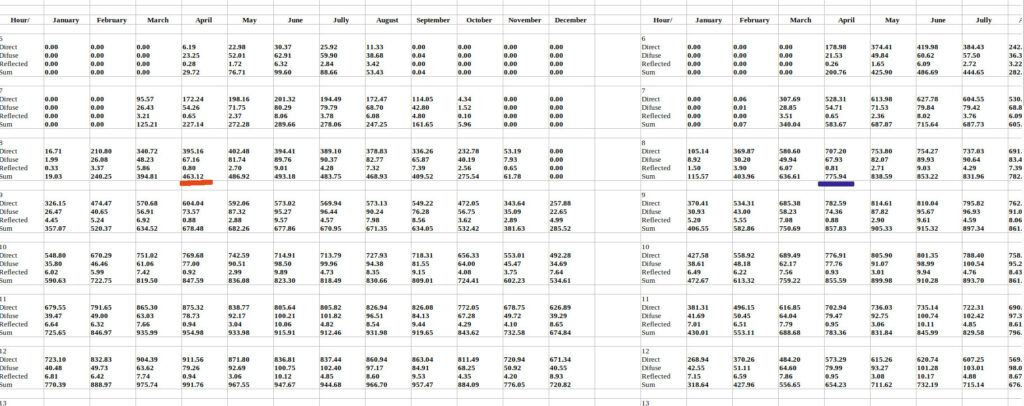 South (left) and East (right) tables comparison
The data confirms our expectations. The east-facing panel starts with maximum operation at sunrise and reaches its maximum at 10 o’clock. After that, it falls, and around 11 a.m., south-facing panels reach it. Depending on the time of year, the direct radiation component disappears around 3 p.m. However, the diffuse and reflected components are still present. The panels continue to operate until the end of the day. With south-oriented panels, as expected, its irradiation increases after morning awakening and overtakes east-oriented panels definitively by 11 a.m., reaching its maximum capacity and slowly decreasing.
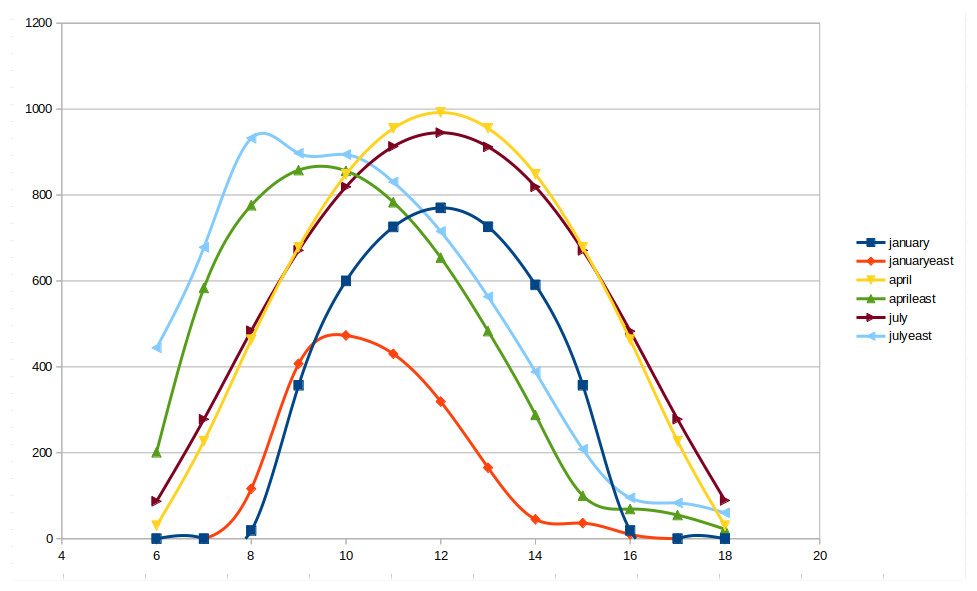
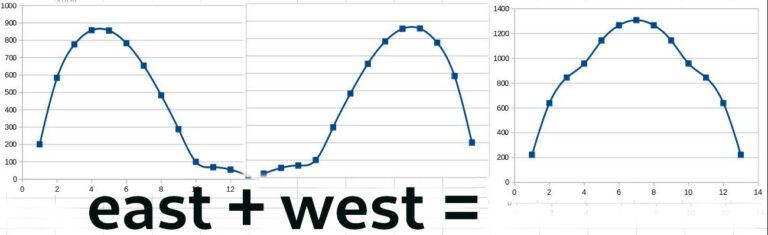
If we make the superposition east and south facing equal numbers of panels, we will get a diagram almost identical to the south-facing panels only.
The next important analysis table that we see after a little scrolling is total energy gain per unit area (kWh/m²/day). After comparing the results for the eastern and southern panels, we get that in this case, the south-oriented panel is better on average for the whole year by about 26%. And finally, let’s check the claim of engineer Dietmar Staudacher that the panels should have as little slope as possible.
Let’s go back to the beginning of the SPAC application. Leave all the parameters the same except for the slope, which we will set to 20 degrees. After the calculation, we get a bulky table, which we will skip and stick only to the table for average daily gains. The calculation results show that the difference dropped to 17%. The table below shows the calculation for a 40-degree slope.
Average monthly production (40° slope)
| FACING | Jan | Feb | Mar | Apr | May | June | July | Aug | Sep | Oct | Nov | Dec |
|---|---|---|---|---|---|---|---|---|---|---|---|---|
| South | 112.82 | 167.35 | 255.68 | 323.95 | 375.15 | 364.51 | 413.81 | 402.29 | 301.91 | 213.00 | 108.88 | 77.11 |
| East | 43.90 | 80.60 | 156.73 | 242.83 | 324.01 | 331.40 | 367.47 | 323.14 | 200.35 | 111.82 | 45.63 | 28.50 |
| % Loss/Diff | 61.09% | 51.84% | 38.70% | 25.04% | 13.63% | 9.08% | 11.20% | 19.67% | 33.64% | 47.50% | 58.09% | 63.04% |
Conclusion
If the situation with our house or roof is such that the orientation is west-east, we can still install solar panels. The investment will be higher, and the loss will depend on the tilt angle (preferably as low as possible). We have to count on a loss of around 17% to 27%. However, we will have electricity from morning until dark, which is convenient if we need a constant flow of energy without sharp midday peaks. Grid operators also benefit from this steady production curve. At a time when solar panel prices continue to drop, east-west systems present a viable and attractive alternative.
Related posts
Can Solar Panels Be Installed on Flat Roof - Flat roof solar
Installation of solar panels on a flat ro...
Solar Panels On The Wall And Roof Together - calculation
When you’re looking to make the most out of solar energy, where you pl...
solar panel balcony
I'm seeing an inventive shift in how city dwellers are tapping into...


